Giving to others selflessly, radiating light through the world and illuminating your own darkness, your virtue becomes a sanctuary for yourself and all beings
-Lao Tzu
Next time you step on your mat, feel the vibration of the energy you cultivate within and share it outwardly with the world. Know that you are doing something to enrich your own life and positively impact the energy of everyone and everything around you.
Ahimsa
The Yoga Sutras of Patanjali is broken down into 4 chapters. Within the chapter sadhana pada, the eight steps for spiritual evolution are described. Yama, Niyama, Asana, Pranayama, Pratyahara, Dharana, Dhyana and Samadhi. Within the Yamas, there are 5 ethics, one of which is ahimsa.
Ahimsa is the ethic of nonviolence. Nonviolence is the very first of all practices explained by Patanjali as it sets the tone for how you practice yoga and interact with others. In a passive sense, ahimsa means to not harm oneself or another physically, verbally or mentally. As an active practice, ahimsa means loving and respecting all everything, including ourselves. It helps to calm the turbulent mind – moving us toward the sattvic or peaceful state that is needed for the higher stages of yoga.
On the yoga mat – Ahimsa is the practice of yielding to the body’s limitations. Pushing too far or having an overly vigorous, obsessive practice does more harm than good. Any yoga practice that depletes the body or causes injury goes against the ethic of ahimsa – to adhere to ahimsa you must lovingly accept yourself – your body.
Happy Birthday His Holiness the Dalai Lama
His Holiness is committed to the promotion of human values such as compassion, forgiveness, tolerance, contentment and self-discipline. He says that as human beings we are all the same. We all want happiness and do not want suffering. He embraces the beauty of diversity in our world and kindness is his religion. I have the utmost respect and admiration for such a beautiful human. If we can aspire to adopt just a fraction of his enlightenment and spirit, we can make our world a more beautiful place.
Perspective- A particular attitude toward or way of regarding something; a point of view.
Yoga is an exploration of perspective. On a literal level, you are consciously placing your body in different positions. It’s the world from a different vantage point – seeing what life feels and looks like with your feet above your head or looking beyond your shoulder, to see your feet. But you shift your perspective on another level, in a quiet reflective way, every time you come to your mat. Even if you are just there to sit, do one pose, or just take savasana. The choice of yoga practice – to slow down, quiet the mind and connect with your breath is bound to be a counterpoint to whatever the rest of your day may be.
“We can complain because rose bushes have thorns, or rejoice because thorn bushes have roses”
-Abraham Lincoln
International Yoga Day-Summer Solstice :)
Yoga is a light, which once lit, will never dim. The better your practice, the brighter the flame.
– B.K.S. Iyengar
Today I am grateful to not only have the opportunity to practice yoga but to teach and share the beauty of yoga with others. May we all take a moment of our day to shine bright and reflect on the beautiful gift of life.
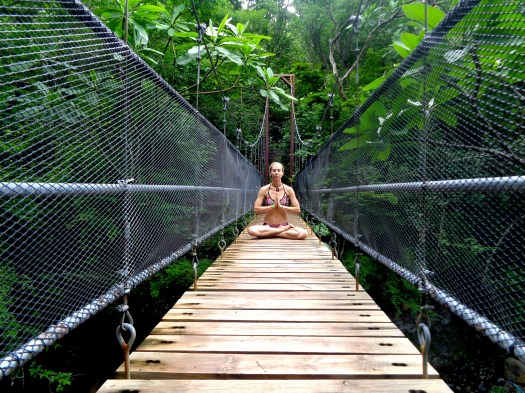
You can’t reach what’s in front of you until you let go of what’s behind you
Letting go takes courage, it takes faith, it takes trusting in something that we often only see glimpses of. In the translation by Sri Swami Satchidananda from the Yoga Sutras (Sutra 1.29) “From this practice, all the obstacles disappear and simultaneously dawns knowledge of the inner self.” During yoga, consciously moving towards ‘letting go’ creates space for becoming more engaged and connected with our inner wisdom and truth. We are no longer held back by limiting beliefs, repetitive thoughts and desires for our practice to look a certain way. We transcend limitations of the mind and body and step into a deeper knowing. And even though doing so can be difficult, it is only when we ‘let go’ that the real yoga begins.
The period of greatest gain in knowledge and experience is the most difficult period in ones life.
– HH the Dalai Lama
Focus on traveling well instead of thinking that it is important that you arrive. Live life like playing a game. There are goals to give it direction, but the true aim is to enjoy playing.
– How Would Buddha Think
Buddha Day/Vesak Day
Awareness increases your self-confidence. You may not understand what is behind a hunch or an impulse, but mindfulness allows you to study motivation and intention. Instead of immediately acting on a hunch or ignoring an impulse, do a mindfulness practice. Listen to and analyze your impulses. Give each moment your intention and awareness. Don’t waste energy battling all the little waves, the ocean is full of them and they keep coming; just pay attention and correct the course when necessary.
As you wake up, welcome the new day with a mindful smile. Ask that you may live each moment with mindfulness and awareness. Ask that you walk on a path of peace and do no harm. Ask that you become more aware.
-How Would Buddha Think
Cadreyoga
🙂
 CadreYoga